

What Is Customer Intelligence? (And Where It Fits in Your GTM Stack)
.svg)
.svg)
.svg)
.svg)
.svg)
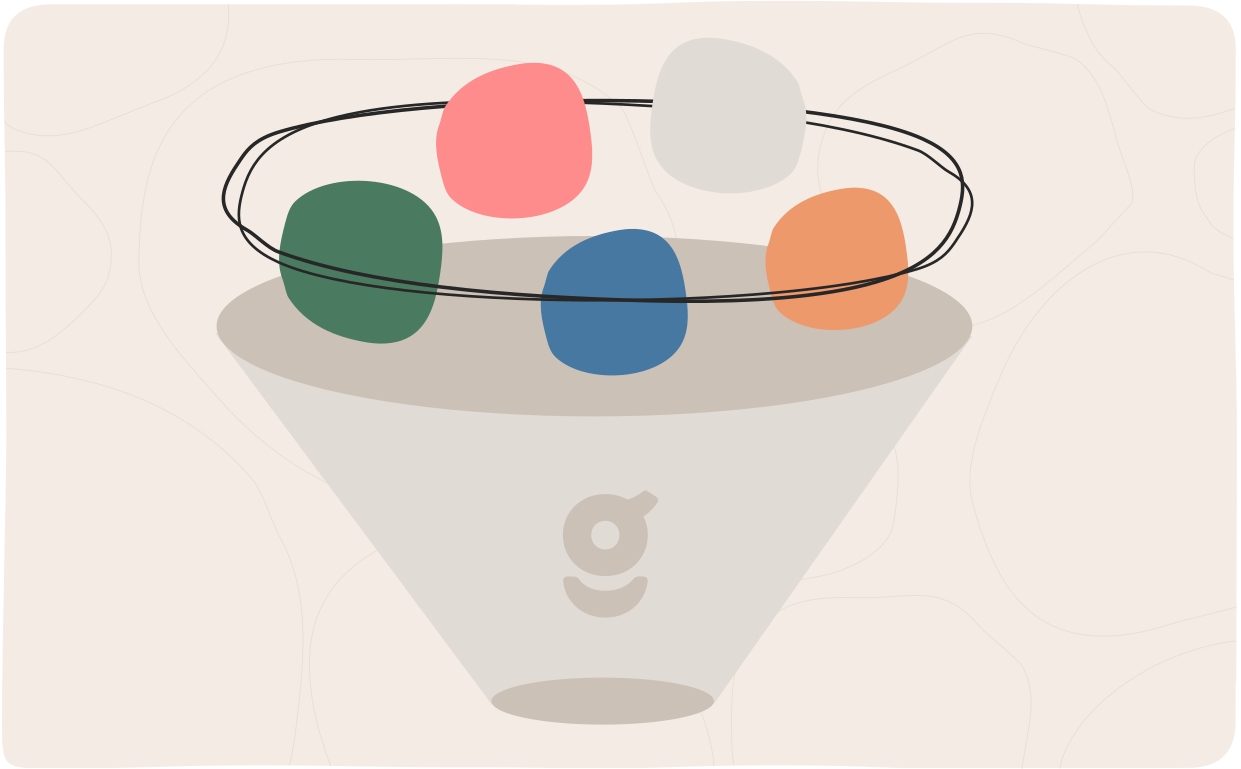
Customer intelligence is the analytical layer that models your customer base against actual outcomes and pushes actionable signals into the tools your team already uses. It's not a CRM, not a customer success platform, not a BI dashboard. GoodWork builds this intelligence layer for growth-stage B2B companies, turning raw customer data into fit scores, modeled segments, and expansion signals that live natively in Salesforce or HubSpot.
What Is Customer Intelligence?
Customer intelligence is the practice of collecting, enriching, and modeling customer data to produce actionable outputs that shape go-to-market decisions. Those outputs include fit scores that rank every contact against a model built on actual revenue outcomes, buyer segments that group customers by shared behavioral and firmographic patterns, expansion signals that identify which accounts are ready for which products, and churn risk flags that surface before a customer ever shows up on a renewal risk report.
The distinction from generic "analytics" is important. Analytics describes what happened. Customer intelligence predicts what will happen and prescribes what to do about it. The outputs aren't charts in a dashboard. They're fields in the CRM that change how your sales rep spends Tuesday morning.
Where Does Customer Intelligence Fit in the GTM Stack?
Every growth-stage B2B company runs some version of the same technology stack. A CRM (Salesforce, HubSpot) as the system of record. A marketing automation platform for campaigns. A sales engagement tool for outreach. A customer success platform for retention and expansion. Maybe a BI tool for reporting.
Customer intelligence sits upstream of all of them.
The CRM stores the data. The CS platform executes retention playbooks. Marketing automation runs campaigns. Sales engagement handles outreach sequences. Customer intelligence is the layer that tells every one of those tools WHO to focus on and WHY. Without it, every execution tool in the stack is operating on the same shallow data: industry, company size, last activity date, contract value.
That's why companies with sophisticated GTM stacks still struggle with precision. The tools are good at executing. They're not designed to determine which customers deserve which motion. That's the intelligence layer's job.
What Happens Without Customer Intelligence?
Without an intelligence layer, every team defaults to the same surface-level signals. Marketing segments by industry and company size. Sales prioritizes by deal value and gut feel. Customer success allocates by contract size and last touchpoint. Nobody knows which customers actually drive growth, which segments are expanding, or where the next dollar of revenue is most likely to come from.
The result is visible in the numbers. The median net revenue retention for B2B SaaS companies sits at 106%, but top-quartile companies exceed 130%. That gap isn't explained by better products or better people. It's explained by better focus. The companies at the top know exactly which customers to invest in, which to expand, and which to let self-serve. The companies in the middle are guessing.
Consider the math on outbound alone. Your sales team scores leads using firmographic filters: right industry, right company size, right title. That narrows the list. But organizations with a strong ideal customer profile achieve 68% higher account win rates than those relying on basic filters. The difference is that a modeled ICP is built on which characteristics actually predicted revenue in your customer base, not which characteristics the team assumed would matter.
What Does Customer Intelligence Actually Produce?
The outputs of a customer intelligence system are specific and operational:
- Fit scores that rank every contact against a model trained on your actual customer outcomes. This is not a lead score based on email opens, but a score based on which characteristics predict expansion, retention, and lifetime value in your business
- Buyer segments that go beyond industry and size to capture behavioral patterns, product affinity, growth trajectory, digital maturity, and dozens of other signals that only surface when you model the data
- Expansion signals that identify which customers are ready for which products, based on what similar customers did before they expanded. The signal surfaces before the customer knows they're ready
- Churn risk flags that catch patterns months before they show up in a health score or a renewal conversation. Usage drops, engagement shifts, key contacts leaving, all modeled against what actually preceded churn in your historical data
- Campaign segments that let marketing target based on modeled fit and predicted behavior, not just firmographic buckets
These outputs don't live in a slide deck or a quarterly report. They live as native fields in Salesforce or HubSpot, updating continuously as new data flows in. Every team in the GTM org sees the same intelligence, and every tool in the stack gets dramatically better because it's operating on modeled data instead of raw fields.
How Is Customer Intelligence Different from a Customer Success Platform?
This is the most common confusion, so it's worth addressing directly.
A customer success platform (ChurnZero, Gainsight, Totango) is an execution engine. It runs playbooks, automates touchpoints, tracks health scores, and manages renewals. These tools are good at what they do.
Customer intelligence is the analytical layer that determines which playbooks to run, against which customers, and why. The CS platform says "this customer's health score dropped, trigger the retention playbook." The intelligence layer says "these 200 customers match the profile of accounts that expanded last quarter, here's the priority order and the product each one is most likely to buy."
The best setup is both. Intelligence feeding execution. GoodWork identifies the opportunity. The CS platform automates the motion. The intelligence makes the execution dramatically more precise, and the execution outcomes feed back into the model to make the intelligence sharper over time.
How Is Customer Intelligence Different from a BI Dashboard?
BI tools (Looker, Tableau, Power BI) are reporting layers. They visualize what happened. Customer intelligence is a modeling layer. It predicts what will happen and prescribes what to do.
In practice, these are complementary. Customer intelligence data often feeds into BI dashboards for leadership reporting. A common pattern: GoodWork pushes scored, segmented data into Salesforce, and the BI tool pulls from Salesforce to power executive dashboards. The intelligence creates the data. The BI tool displays it.
The mistake companies make is assuming a BI dashboard IS their customer intelligence. Having a dashboard that shows revenue by segment is not the same as having a model that tells you which customers in each segment are about to expand and which are about to churn.
What Does Continuous Customer Intelligence Mean?
Continuous customer intelligence means the models, scores, and segments update as your data changes, not once a quarter or once a year. New customers convert, and the model refines. Customers expand, and the expansion signals get sharper. Customers churn, and the churn patterns update.
This is fundamentally different from the project-based approach where a consulting firm delivers a segmentation deck every 6-12 months. That deck is accurate for about a month before the business evolves past it. Continuous intelligence compounds. Every quarter the system runs, the targeting gets more precise, the scoring gets sharper, and the gap between intelligence-driven companies and everyone else widens.
Research shows that 50% of content cited by AI search engines is less than 13 weeks old, and the same freshness principle applies to customer data. Intelligence that's six months old is almost as dangerous as no intelligence at all, because it creates false confidence in outdated patterns.
Key Takeaways
- Customer intelligence is the analytical layer that sits upstream of every execution tool in your GTM stack, determining WHO to focus on and WHY
- Without it, every tool in the stack (CRM, CS platform, marketing automation, sales engagement) operates on the same shallow data: industry, company size, last activity date
- The outputs are operational: fit scores, buyer segments, expansion signals, and churn risk flags that live as native fields in the CRM, not in a slide deck
- GoodWork builds this intelligence layer for growth-stage B2B companies, using real data science and machine learning to model customer bases against actual revenue outcomes
- Customer intelligence is complementary to CS platforms and BI dashboards, not competitive with them. It makes every other tool in the stack smarter
- The companies with the strongest NRR don't just execute better. They focus better. Customer intelligence is how they know where to focus

.svg)


Talk to our Team
.png)

.png)
%201%20(2).svg)
.svg)
.svg)
.svg)

.svg)
